Team Performance
Turning a group of executives into a team that decides and delivers
We work with boards, top teams and teams leading major strategic projects. The aim is not just to get along better, but to speak up and to listen, work through disagreement, and find the shared purpose that lets a team decide together and deliver on its strategy.
Who we work with
- Executive committees and top teams
- Subsidiary and business unit leadership teams
- Teams leading major strategic projects
- Boards of directors and supervisory boards
We are brought in
- either by a leader who wants to work through a situation with their team,
- or by HR leaders supporting a reorganisation or the arrival of a new leader.

The situations we work on
✓ A new leader stepping in
Setting the ground rules together and anchoring their legitimacy.
✓ Reshaping the top team
Building one team from incumbents and newcomers, united by a shared ambition.
✓ Launching a project team
Getting a cross-functional team up and running fast, aligned on outcomes and able to meet its deadlines.
✓ Decisions that never land
Deciding together for real, then carrying the decision into the business.
✓ Working in silos
Opening up the real issues and turning confrontation into collective energy.
✓ Board effectiveness review
An externally facilitated review that strengthens the board and its work with management, while meeting governance code expectations.
Where and how?
Our work takes place on your premises or in venues we select together, in France and across Europe; in French and in English, and in Spanish on a case-by-case basis.
For collective sessions, we usually work as a pair: a team to work with a team.
Where language or a specific expertise calls for it — a learning expedition abroad, for instance — we bring together a dedicated team.
How we work
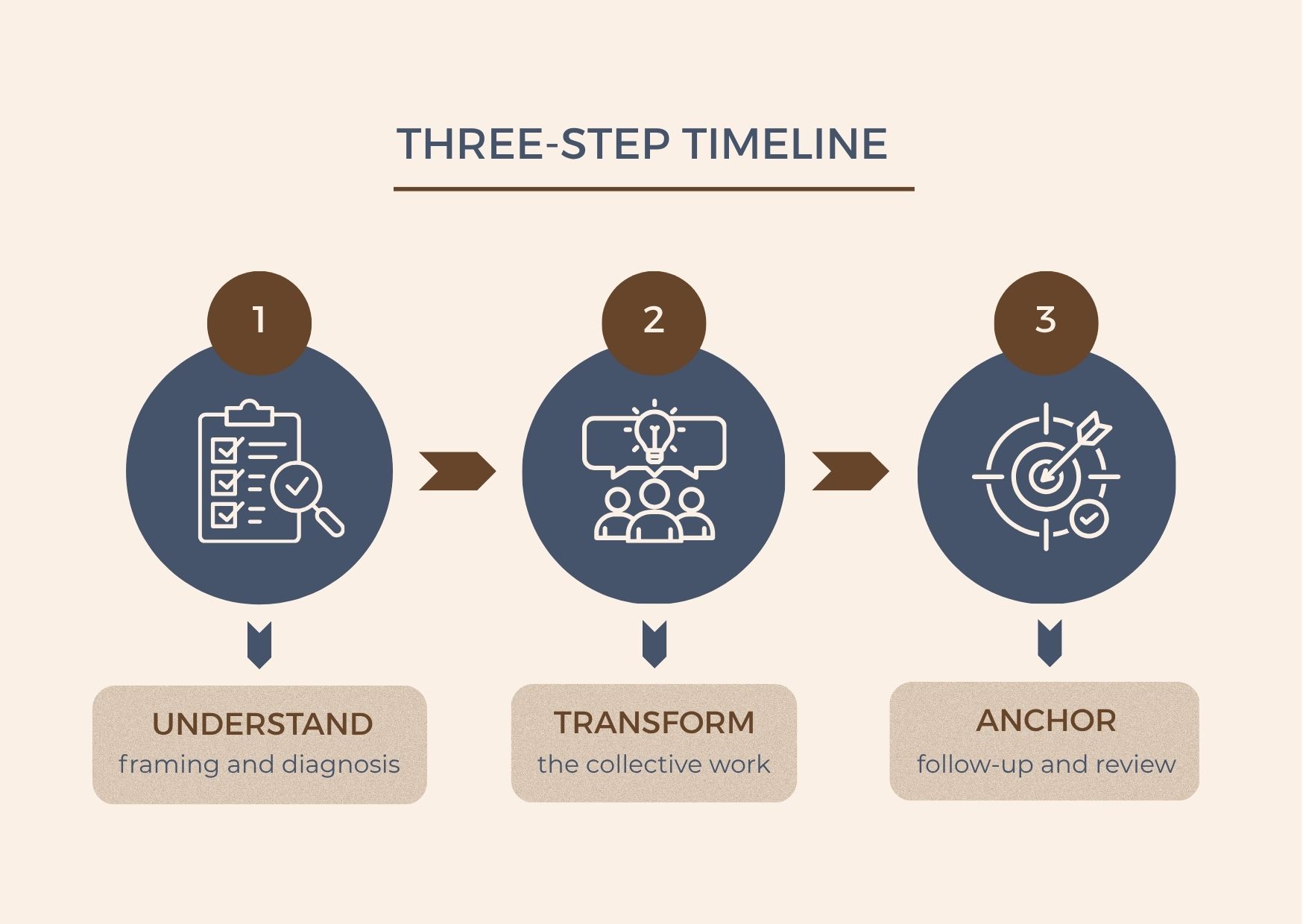
How a team engagement unfolds
1. Understand – framing and diagnosis: a first session with the leader, on the situation and the changes they are looking for. Depending on the stakes: individual interviews, observation of a working session, a measure of working preferences. We give the team back a clear picture of the real issues, without exposing who said what.
2. Transform – the collective work: one or more dedicated sessions, a one- or two-day offsite, or three- to four-hour sessions spread over several weeks. The team builds its relational foundations, its shared purpose and its ground rules.
3. Anchor – follow-up and review: six to twelve months on the team’s real ways of working: preparing meetings, applying the agreed rules, working through disagreement, adjusting positions and roles. The team becomes more autonomous. Individual coaching for some members can be added.
Some of the tools and models we draw on
DISC
Giving the team a shared language for how each person acts and interacts, one that stays with them after the engagement.
MBTI
Understanding how the team is composed: which ways of thinking and deciding dominate, which are missing, and what this produces in practice.
Process Communication Model
Spotting in real time what is blocking between certain members, particularly under stress, and giving them the means to defuse it.
Organisational constellations
Bringing a stuck situation to light differently, when rational analysis is not enough.
The Journey of Perseus
Restoring a sense of purpose and momentum to a team that has lost them, through a symbolic and playful journey.
YOUR QUESTIONS
My executive committee is not working well. Should we work on the team, or on its members one by one?
The team. The difficulties rarely come from individuals: they sit in the unspoken rules — what gets settled one to one, what is never said at all.
Individual coaching can follow, as a complement.
This work includes you too. A committee largely works the way its leader makes it work — and that is your greatest lever.
We have already run two offsites on team cohesion with no lasting effect. What would be different?
An offsite on its own does not change how a group works.
What produces lasting effect is what happens not only during, but before and after: individual interviews beforehand, a debrief that pulls no punches, then a few follow-up points over six to twelve months.
The offsite is one moment of the process. Not the process.
Where does your team stand?
A first conversation gives us an initial read on the situation
and lets us assess whether team coaching is the right answer.
Explore our other offerings